
Winter Squash
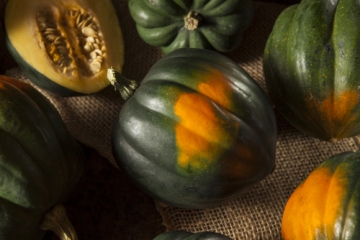
Winter squash have tough, thick shells that protect their sweet flesh, making them excellent storage vegetables. The most common varieties of winter squash include acorn, butternut, Hubbard, spaghetti and turban.
Did You Know?
- Winter squash are an excellent source of beta-carotene, and a good source of fiber, vitamin C and niacin.
- Winter squash differ from summer squash because they are harvested and eaten in the mature fruit stage, when the seeds within have ripened fully and the skin has hardened into a tough rind.
- With the exception of spaghetti squash, virtually any winter squash can be substituted for another in recipes.
- The darker the flesh of the squash, the more beta-carotene and other nutrients it contains.
Shopping, Preparing and Storing
- Choose winter squash that are heavy for their size and have a hard, deep-colored rind.
- The hard skin of winter squash protects the flesh and allows it to be stored longer than summer squash. Winter squash can be kept in a dark place for one to three months depending on the variety.
Cooking Tips
- Acorn squash is good for baking and goes well with a sweet or nutty stuffing.
- Cooked butternut squash has a fine-grained flesh that makes it perfect for pureeing.
- When spaghetti squash is baked, its flesh forms translucent thin strands that can be used as a substitute for spaghetti.
- Baking is the most popular way to prepare winter squash, but it can also be steamed, mashed or pureed.
Winter Squash Nutrition
Serving size: 1/2 cup butternut squash
Calories: 31; Total Fat: 0 g; Saturated Fat: 0 g; Total Carbohydrates: 8 g; Protein: 1 g; Sodium: 3 mg
Download a flyer to print about Florida
winter squash
[
 1.1 MB
]
.
1.1 MB
]
.


