
Black-Eyed Peas
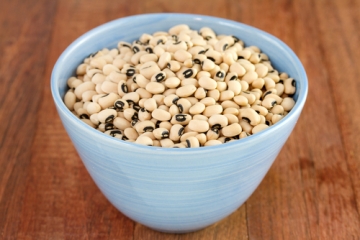
In many cultures, black-eyed peas are eaten on New Year’s Day for good luck and prosperity. In the United States, black-eyed peas are also known as “Southern peas,” “cowpeas” and “black eyes.”
Did You Know?
- Although black-eyed peas are called a pea, they are actually considered to be a bean.
- Black-eyed peas have the ability to take nitrogen from the atmosphere and make it into fertilizer.
- Just ½ cup of black-eyed peas provides more than 20 percent of the daily recommended amount of fiber.
- Black-eyed peas are a good source of protein and iron.
- 1 cup of dry black-eyed peas makes about the equivalent of 3 cups of cooked peas.
Shopping, Preparing and Storing
- Black-eyed peas are available dried, canned and frozen.
- Choose dried beans or canned beans with low or no sodium added. Select dried beans that are firm, dry, clean and uniform in color.
- Store dried beans at room temperature, in a closed container to protect from moisture and pests. Store canned beans at room temperature and be sure to use them before the date on the can.
Cooking Tip
- Cooked black-eyed peas can be used in bean salads, soups, stews, casseroles and chili. They can also be served as a side dish.
Black-Eyed Pea Nutrition
Serving size: ½ cup
Calories: 79; Total Fat: 0 g; Saturated Fat: 0 g; Total Carbohydrates: 17 g; Protein: 3 g; Sodium: 188 mg
Download a flyer to print about Florida
black-eyed peas
[
 1.1 MB
]
.
1.1 MB
]
.


