
Collard Greens
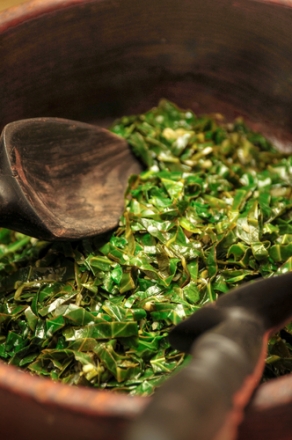
A popular staple among people in the Southeast, collard greens, unlike kale and mustard greens, have a very mild, almost smoky flavor. Collard greens are low in calories and fat, are cholesterol-free and provide an array of important nutrients such as vitamins A, C and K, as well as folate, calcium and fiber.
Did You Know?
- Collard greens belong to the same family that includes cabbage, kale and broccoli.
- Collard leaves that are smaller in size will have a milder flavor and are often more tender than larger leaves.
- Collard greens grow as a loose bouquet instead of in a tight head like other cabbages.
- Collard greens are traditionally slow-cooked with pork or turkey but can also be quickly cooked like cabbage.
- In Florida, collards thrive under a wide range of conditions and can easily be grown throughout most of the year.
Shopping, Preparing and Storing
- Look for collard greens that have firm, unwilted leaves that are deep green with no signs of yellowing or browning.
- Freshly harvested collard greens should be washed and then stored in a plastic bag for up to five days in the refrigerator.
Cooking Tips
- Collard greens may require 20 minutes to an hour of cooking depending on their maturity (toughness). You can tell that they are done when they turn bright green.
- Collard greens can be steamed, boiled, braised or sautéed.
- It’s important to not overcook collard greens. Like other cruciferous vegetables, collard greens will emit an unpleasant sulfur smell when overcooked.
Collard Green Nutrition
Serving size: 1/2 cup cooked greens
Calories: 10; Total Fat: 0 g; Saturated Fat: 0 g; Total Carbohydrates: 1 g; Protein: 2 g; Sodium: 11 mg
Download a flyer to print about Florida
collard greens
[
 1.2 MB
]
.
1.2 MB
]
.


