
Classical Biocontrol
Program Manager/Lead Scientist: Emily.Kraus@FDACS.gov
Biological Scientist: Gloria.Lotz@FDACS.gov
With increased international travel and commerce, there is an increase in pest introductions to the state of Florida. There are not enough resources to stop every pest at the border. In cooperation with various government agencies, private companies, and universities, the Florida Department of Agriculture and Consumer Services' (FDACS) Division of Plant Industry is involved in the research, rearing and release of beneficial insects to control invasive plants and pests of plants and honey bees that threaten Florida's native and commercially grown plants and agricultural resources.
Asian Citrus Psyllid
Asian Citrus Psyllid (ACP), Diaphorina citri (Hemiptera: Psyllidae), was discovered by FDACS personnel in Boynton Beach, Florida, in June 1998. It quickly spread to all citrus producing counties in Florida. ACP is one of the most efficient vectors of citrus greening disease, which was found in Florida in 2005. Infection with citrus greening, or Huanglongbing (HLB), results in a systemic tree infection leading to poor fruit production and tree decline.
In cooperation with University of Florida's Institute of Food and Agricultural Sciences (UF/IFAS), two parasitoids of the psyllid, Diaphorencyrtus aligarhensis (Hymenoptera: Encyrtidae) and Tamarixia radiata (Hymenoptera: Eulophidae), were introduced into FDACS's quarantine laboratory in 1998. A permit for field release of T. radiata was granted in July 1999 and for D. aligarhensis in March 2000.
Tamarixia radiata quickly established and can be found throughout Florida providing varying levels of ACP control. Diaphorencyrtus aliharhensis is not known to have established to date. However, augmentative releases of this wasp do provide additional psyllid control.
Both parasitoids are mass reared and distributed to researchers and citrus growers throughout Florida. In 2012 alone, approximately 1.5 million T. radiata and D. aligarhensis were distributed.
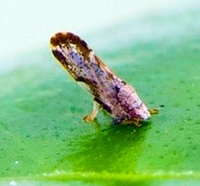
An adult Asian citrus psyllid (ACP)
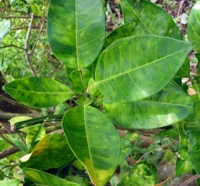
Citrus leaves showing a blotchy mottle
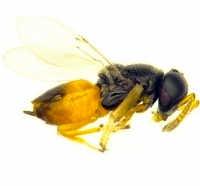
Female Diaphorencyrtus aligarhensis endoparasitoid
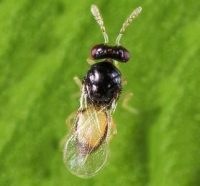
Female Tamarixia radiata ectoparasitoid
Citrus Leaf Miner
Citrus leaf miner (CLM), Phyllocnistis citrella (Lepidoptera: Gracillariidae), is a serious pest of citrus first detected in Florida in 1993. CLM quickly spread throughout all citrus producing counties, inducing large amounts of damage. CLM larvae burrow through leaf tissue, destroying new growth while creating entry points for tree infection with citrus canker, a serious bacterial disease.
A CLM parasitoid, Ageniaspis citricola (Hymenoptera: Encyrtidae), was imported from Australia in 1994. It rapidly established and spread throughout Florida, inducing high levels of CLM mortality.
FDACS continues to rear and release A. citricola, especially in areas infested with citrus canker.
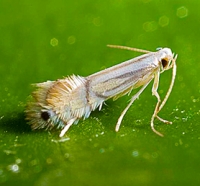
Citrus leaf miner (CLM) adult
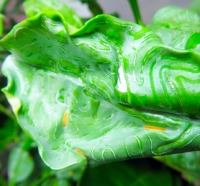
CLM larvae infested citrus leaf displaying typical larval mining damage
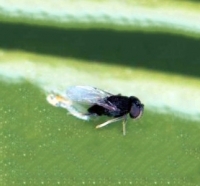
Ageniaspis citricola adult female parasitizing a CLM larva
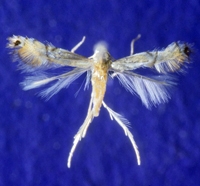
Citrus leaf miner adult pinned specimen
Air Potato Vine
Air potato, Dioscorea bulbifera, is an invasive, high climbing vine capable of outcompeting native vegetation and displacing other organisms. It forms dense blankets that smother native trees and understory plant species. Air potato is listed as a noxious weed by FDACS and a Category I invasive plant by the Florida Exotic Pest Plant Council.
Current air potato management methods have proven temporary and ineffective. Chemical control is costly and requires repeated basal and foliar sprays over several years. Damage or death to non-target plants often occurs during these treatments. Additionally, new vines may continue to sprout from underground tubers when herbicide treatments cease. Mechanical control of air potato is labor intensive and time consuming. Eradication requires the removal of underground tubers, which can be difficult to access and completely remove.
Through a collaborative partnership with the United States Department of Agriculture Agricultural Research Service Invasive Plant Research Laboratory (USDA-ARS-IPRL) in Ft. Lauderdale, Florida, FDACS is researching, mass rearing, and distributing Lilioceris cheni (Coleoptera: Chrysomelidae), a leaf-feeding beetle that feeds solely on D. bulbifera. USDA-ARS-IPRL scientists introduced the beetles into quarantine from China and Nepal. A permit to release the beetles was granted in 2011.
Lilioceris cheni is a voracious feeder and shows much promise as a successful biological control agent of air potato. FDACS began releases in the summer of 2012. Beetle populations have increased at release sites, inducing varying levels of damage. Lilioceris cheni is being widely distributed on both public and private lands throughout Florida.
For further information on biological control of air potato, including how to request beetles for release on your property, visit: Air Potato Vine Biological Control
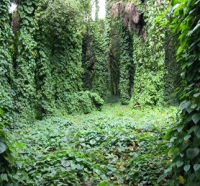
Air potato vine infestation smothering native vegetation in Florida
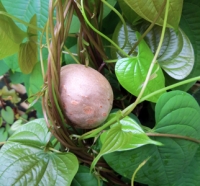
Dioscorea bulbifera bulbil (aerial tuber) commonly called an air potato. Bulbils serve as the primary means of vine dispersal.
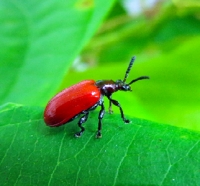
Adult Lilioceris cheni beetle
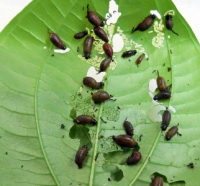
Lilioceris cheni late instar larvae feeding on an air potato leaf
Photo credits: Jeffrey Lotz-DPI; Suzanne Fraser-DPI


