
Program Resources
Publications:
- Air Potato Beetle Biology
-
Air Potato Beetle Fact Sheet
[
 221 kB
]
221 kB
]
-
Air Potato Beetle SOP
[
2.7 MB
]
-
Biological Control FAQ
[
145.6 kB
]
- Economics of Air Potato Beetle
Additional Information:
Air Potato Vine Biological Control
Changes to the Air Potato Vine Biocontrol Program
-
Air Potato Beetle Distribution Update
[
387 kB
]
Report Air Potato Vine in Florida
Report Air Potato Vine out of State
The air potato vine ( Dioscorea bulbifera L., Dioscoreaceae) was introduced into the United States in Alabama during the late 1700s and southern Florida in the early 1900s. Since then, it has spread throughout Florida, Alabama, Georgia, Hawaii, Louisiana, Mississippi, South Carolina and Texas. The Early Detection and Distribution Mapping System shows vine infestations in all 67 Florida counties. Air potato vine is considered one of the most aggressive weeds ever introduced into Florida. It forms dense blankets that smother native trees and understory plant species. It can be managed with the biological control agent Lilioceris cheni Gressit & Kimoto (Coleoptera: Chrysomelidae), also known as the air potato beetle, or through mechanical and chemical means.
Air Potato Vine
The air potato vine has a wide native range, including much of Asia, tropical Africa and northern Australia. The vine grows rapidly, climbing tree canopies and crowding out native plant species. It can persist in poor soil types and generates large numbers of bulbils, from which new vines sprout. In Central and South Florida, it is considered one of the more common natural area weeds. Most natural and disturbed habitats are susceptible to air potato infestation, including floodplain forests, marshes, scrub forest, sinkholes, tropical and subtropical hammocks, waterways and urban lots. Air potato is listed as a noxious weed by the Florida Department of Agriculture and Consumer Services (FDACS) and by the Florida Exotic Pest Plant Council as a Category I invasive plant. Category I invasive plants are defined as "species which are altering native plant communities by displacing native species, changing community structures or ecological functions, or hybridizing with natives."
In spring, air potato vines sprout from underground tubers and bulbils that were dropped during the previous growing season. The vines cannot support their own weight and will climb vegetation to reach sunlight. Vines grow 1.5-11.8 centimeters a day and up to 23 meters total. Air potato vine covers native vegetation quickly, limiting its access to light. Even vines that have been fed on by beetles will continue to grow for the entire growing season, another characteristic that makes air potato vine a successful invader. As temperatures drop, the vine will begin to allocate resources to reproduction, generating bulbils, and begin leaf senescence. Flowers and seed production are rare in Florida. Bulbils, which can weigh up to 1 kilogram, will drop to the ground, where they will sprout new vines the following season. The underground tubers will also overwinter and produce new vines in the spring.

Air potato vine infestation smothering native vegetation in Florida
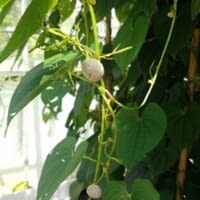
Air potato bulbils growing on the vine. Bulbils can grow from the size of a pea to the size of a grapefruit.
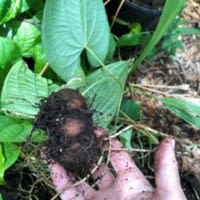
Freshly unearthed tubers. Tubers can get very big if allowed to grow for multiple years.
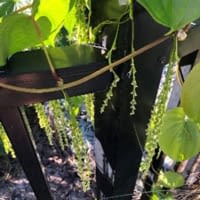
Flowering air potato
Air Potato Vine Biological Control
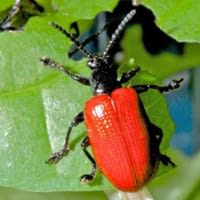
The Chinese biotype of the air potato beetle, distinguishable by its striking red elytra
Most air potato management methods have proven temporary and ineffective. Chemical control is costly and requires repeat basal and foliar sprays over several years. Damage or death to non-target plants often occurs during these treatments. Additionally, new vines often continue to sprout from underground tubers when herbicide treatments cease. Mechanical control of air potato is labor intensive and time consuming. Temporary removal is possible when vines and bulbils are hand-collected and destroyed. Eradication, however, requires the removal of underground tubers, which can be difficult to access and completely remove.
Biological control was determined to be the most promising management strategy for this invasive plant after the discovery of the air potato beetle, which feeds exclusively on air potato. Laboratory production of tens of thousands of beetles is more cost effective than mechanical and chemical control methods. Beetles representing two different biotypes were collected from locations in Nepal and China. Host-specificity testing was performed on 41 non-target species, and L. cheni was found to be highly host-specific. Release and establishment of the beetle in Florida have resulted in a massive reduction in vine biomass, bulbil production and spread of the vine. This program can be considered one of the major successes in the field of biological control.
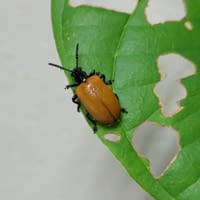
The Nepalese biotype of the air potato beetle. The elytra of this biotype appear orange-brown.
Through a collaborative partnership with the U.S. Department of Agriculture’s Agricultural Research Service Invasive Plant Research Laboratory (USDA-ARS-IPRL) in Fort Lauderdale, Florida, FDACS is researching, mass rearing and distributing the air potato beetle. USDA-ARS-IPRL scientists introduced the beetles into quarantine from China and Nepal. A permit to release the beetles was granted in 2011, and FDACS began releases in 2012.
The life cycle of the air potato beetle is holometabolous (meaning the insect undergoes a complete metamorphosis) and spans 28 days, allowing for rapid production. Adult beetles bite the leaf veins, resulting in cupping of plant leaves. Eggs are most often laid in the cupped leaves. This is an important indicator used to assess oviposition rates (egg-laying rates) in the mass-rearing program. It has been reported that female adults can lay more than 1,200 eggs in their lifetime. The pale white eggs will become yellowish if fertilized, and larvae will eclose (hatch) in approximately four days.
First instar larvae are also yellowish but become gray to red with black legs as they progress through the four larval instars. The larval stage lasts approximately eight days. After this time, larvae will drop off the plant and cluster in the soil to pupate. They secrete a substance that solidifies into a hard puparium (shell). The pupal stage lasts approximately 14 days. Adults emerge and require approximately 10 days before mating begins and the cycle continues. Adults are assumed to live over five months. They have also been observed to go several weeks without food. Immediately after emergence, adult insects must have a food source or they will die within several days. Insects that are provided a food source immediately postemergence can survive with minimal dietary resources, especially those that overwinter as adults. Larvae will not survive without leaf material.
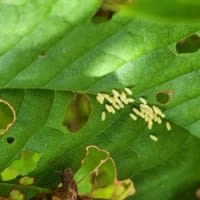
Air potato beetle eggs deposited on a leaf
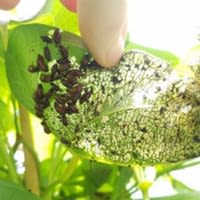
Air potato beetle larvae feeding on the underside of a leaf
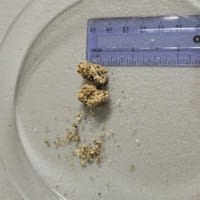
Pupation cases pulled out of a bin of vermiculite
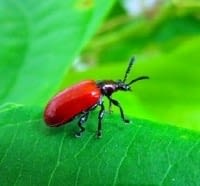
Adult air potato beetle
Field observations suggest that beetles have successfully overwintered in Florida for several years. When beetles emerge from diapause, a period of suspended development, there is a short period before feeding on vines begins, likely due to post-diapausal physiological changes. Adults kept outdoors during the mass-rearing process will also experience this phase of reduced feeding behavior. After adults begin feeding on vines, they will begin to mate and lay eggs in areas with sufficient air potato tissue. Beetles will completely defoliate plants if allowed to do so. It is vital, therefore, to monitor oviposition and beetle density in rearing rooms so as not to allow vines to be completely defoliated. Much is still unknown about beetle overwintering and diapause. The critical threshold for temperature is unknown, and the impact of a complex of viruses has not been studied. In addition to mass-rearing beetles, there is a need for experimental field- and laboratory-based research to answer these questions.
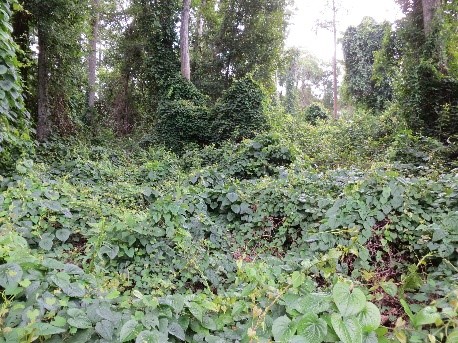
Field site in Gainesville, Florida, before air potato beetle release
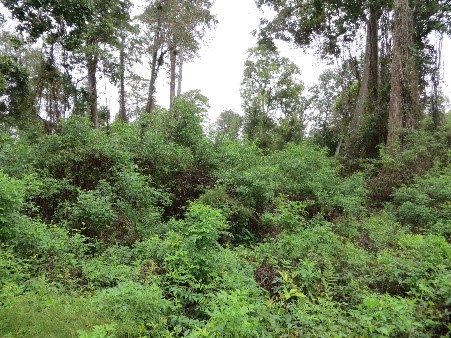
Gainesville field site 14 months after air potato beetle release
Rearing Air Potato Beetles
The Division of Plant Industry has a facility in Gainesville for mass-rearing the beetles. This facility is supervised by two biological scientists and further staffed with two laboratory technicians. To rear air potato beetles, the team must grow air potatoes. Each year over a thousand pounds of bulbils are collected for this purpose. Growing the vines begins during winter in greenhouses while temperatures outside are still cool. Small numbers of beetles are released in these areas to begin the summer colony. These adult beetles consume leaves, mate and lay eggs on the small new leaves. After eggs eclose, the larvae continue to consume tissue voraciously. The fourth instars are collected by hand and placed indoors on vermiculite where they pupate. During pupation they undergo a major physical change called metamorphosis and emerge as adult beetles. These adults are collected and shipped to land managers of conservation areas and preserves and to hundreds of Florida residents. As the temperature rises, rearing moves to larger outdoor areas where tens of thousands of beetles are produced annually.
Program Resources
Publications:
- Air Potato Beetle Biology
-
Air Potato Beetle Fact Sheet
[
221 kB
]
-
Air Potato Beetle SOP
[
2.7 MB
]
-
Biological Control FAQ
[
145.6 kB
]
- Economics of Air Potato Beetle
Additional Information:


