
Contact Us
Questions? Please call us at (321) 697-1400.
Program Resources
- Arboviral Encephalitis Case Information Form[
 ]
] - Contagious Equine Metritis Submission Form[ ]
- Continuation Form for Accession Submission[ ]
- Create Shipping Labels
- Disclaimer for Owner-Submitted Accessions[ ]
- Equine Viral Arteritis (EVA) Submission Form[ ]
- General Submission Form[ ]
- Lab Web Portal
- Laboratory Tests and Fees
- Pay Lab Fees Online
- Tick Identification Submittal Form[ ]
General Guidelines for Sample Submissions
The following are some general guidelines for submitting samples for testing at the Bronson Animal Disease Diagnostic Laboratory:
- Whenever possible, collect the specimen prior to administration of antimicrobial agents.
- Collect the specimen by aseptic means and transport in a sterile container.
- Collect an adequate amount of specimen. If in doubt, please call the laboratory.
- Provide a relevant, concise clinical history with the submission.
More Specific Requirements
Select a lab section to learn more.
Bacteriology
Anaerobic Culture
Anatomic sites likely to contain anaerobic bacteria contributing to the disease process are closed cavities such as peritoneal cavity, joint space, and para-nasal sinus. The following specimens are generally unacceptable for culture of non-spore-forming anaerobic bacteria:
- Aerobic swabs from any site
- Gastrointestinal specimens
- Fecal or rectal swabs
- Throat or nasopharyngeal swabs (unless from an abscess)
- Gingival swabs (unless surgically obtained from abscessed tooth root)
- Vaginal, cervical or urethral swabs
- Voided urine
- Tracheal washings
- Swabs from surface of ulcers, skin lesions and fistulous tracts
Fecal Culture
When submitting fecal or cloacal specimens, understand the laboratory's identification schemes to allow the ruling out of pathogens:
- "Salmonella only" — media selected to recover only Salmonella
- "Enteric pathogens" — media selected to recover Salmonella, Yersinia, Aeromonas and Plesiomonas
- Psittacine birds — Cloacal cultures are routinely set up for any gram negative bacterium.
- A specific request will be needed for Campylobacter jejuni, Vibrio cholerae or Johne's culturing.
Fungal Culture
- Fungal cultures are routinely conducted on chronic nasal discharges, aborted fetal tissues, tissue granulomas, and corneal/conjuntival specimens because of the prevalence of fungal infections at these sites.
- Do not overinoculate vials of dermatophyte test medium (DTM) with hair/scrapings. Plant only two to three diseased hairs.
- Do not hold inoculated DTM cultures until the medium turns red. Bacteria and saprophytic fungi will each turn the medium red, so ship immediately.
Culture and Sensitivity
Culture and sensitivity are separate tests to be requested. Most bacteria recovered from submitted specimens are environmental or commensal and do not warrant antimicrobial sensitivity testing.
- "Culture only" — no antimicrobial testing will be done.
- "Call before antimicrobial testing" — Laboratory will call clinician before testing an isolated strain.
- "Pathogens only" — testing on known pathogens (e.g., Salmonella)
- "Culture and Sensitivity" — antibiotic testing on frank pathogens and opportunistic pathogens. The laboratory will err on the conservative side by testing bacteria like Klebsiella, Pseudomonas, Acinetobacter, and DNase (+) Staphylococci. The laboratory does not routinely conduct sensitivity testing on bacteria of low virulence, such as DNase (-) Staphylococci, non-beta hemolytic Streptococci, or Enterobacter.
Clinical Pathology
Specimen Size
Be sure to submit a sufficient amount of serum for testing. Almost every test in our laboratory requires 0.5 to 1 ml of serum.
Labeling
All tubes, containers, bags, slides and swabs submitted must be adequately labeled. Specimen type, name of the patient, and information pertinent to the practitioner should be included on the label.
Blood Film
Blood film must be prepared as soon as possible to minimize artifactual cellular changes. Smears should be rapidly dried with a blow dryer to eliminate artifacts of air-drying red blood cells. Make sure the distribution of cells is even and thin.
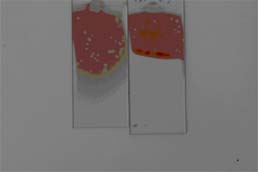
Undesired blood film. The smears are too thick. |

Adequate blood film |
Hemolysis
To prevent serum hemolysis, it is ideal to submit only chilled serum instead of whole blood for testing. Specimens must be submitted and processed as soon as possible.
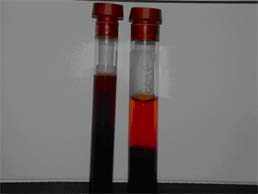
Hemolysis
Cytopathology
Cytological Specimens
When submitting cytological specimens, make a thin preparation. Material should be located at one edge of the slide and homogeneously smeared. It is recommended to submit two smears, one with no fixative, and the second cytospray-fixed right after the specimen is smeared.
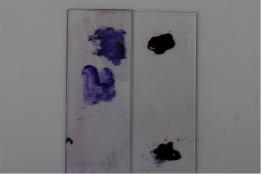
Undesired cytological specimen: Thick material located in one spot, not distributed and smeared all over the slide |
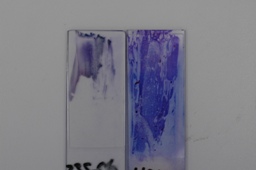
Adequate cytological specimen |
Fluid Specimen Submission
Fluids must be submitted in a plastic or glass tube. For safety purposes, no syringes and/or needles should be submitted.
It is important to submit and process the fluids as soon as possible for cytopathological evaluation. If the fluid is not to be processed within the next 24 hours, it is recommended to add 1/4 parts of alcohol to the total fluid volume. Or 1/4 parts of alcohol in 3/4 parts of specimen. Bloody fluid can be submitted in a purple-top (EDTA) tube for good preservation.
Please indicate on the submission form if alcohol was added to the specimen.
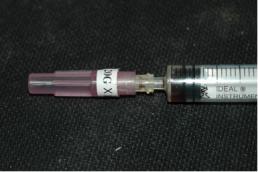
Inadequate fluid specimen submission |
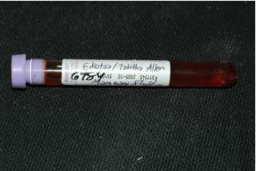
Adequate fluid specimen submission |
Vaginal/Endometrial Submissions
After obtaining the sample, the cotton tip must be gently rolled on a glass slide. The already-prepared smear must immediately be cytosprayed or air-dried. Do not leave the smear in the open as it can get contaminated.
The swab should not be submitted for cytopathological testing. The swab is only useful for bacteriological, mycotic evaluation. The cells dry out and die when left in the swab.
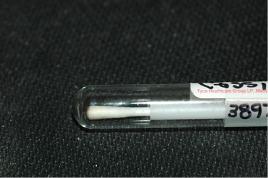
Undesired vaginal/endometrial swab |
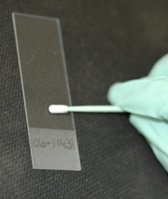
Adequate submission |
Histopathology
For best results, specimens intended for histopathological examination should be submitted in 10 percent formalin. Formalin must penetrate the tissue completely to preserve detail critical to accurate microscopic evaluation. For this reason, tissue must be completely immersed in a generous quantity of formalin (a tissue-to-formalin ratio of 1:10 is ideal). Large specimens (greater than 2 centimeters in diameter) should be partially incised (every 1 centimeter or so) so that fixative can penetrate the tissue.
Cytologies
For cytologies, smears of aspirates or imprints of tumors and skin lesions should be prepared immediately following collection, air-dried, and then fixed in methanol or sprayed with a commercial fixative such as Spray-cyte prior to shipment. Plastic stacking-type slide containers tend to better prevent slide breakage during transit as compared to flat cardboard or plastic slide holders. If cytology is required on a fluid, slides should be immediately prepared after the specimen is collected and/or the fluid placed in a fixative solution (an EDTA blood tube is usually ideal) and shipped chilled overnight. A red top tube of the fluid can also be submitted chilled (and shipped overnight) for culture or other testing if desired.
Molecular Biology
Sample Collection for Avian Influenza or Newcastle Disease Virus Real Time Polymerase Chain Reaction (RT-PCR) Tests
- The preferred specimens for the RT-PCR assay are tracheal or oropharyngeal swabs from gallinaceous birds such as chickens, turkeys, guinea fowl, pheasants, quail, etc. For other birds, such as ducks, geese, etc., cloacal swabs are preferred.
- The RT-PCR has not yet been validated for use in testing pet (caged) birds so the sample site at which the virus can be detected is not established. For this reason, in non-poultry or wild waterfowl, both oropharyngeal and cloacal areas will need to be swabbed and the samples kept separate. For non-export testing, PCR will be followed up with Virus Isolation.
- Polyester-tipped metal or plastic sticks (synthetic material on a synthetic shaft) are the preferred type of swabs. Wooden sticks contain inhibitors that affect the assay. Do not leave wooden-shafted swabs in the medium.
- Swabs must be placed in brain-heart-infusion broth (BHI) tubes. Both swabs and BHI tubes can be obtained from suppliers such as VWR. Please note that the BHI broth does not have antibiotics added and the volume needs to be between 2 and 2.5 millliliters so you will need to pour half of the volume from these 5-ml tubes into a sterile vessel to have the right volume for the test. Swish swabs in the BHI for 10 seconds, wring them out against the edge of the tube, and discard them before sealing the tube.
- Label tubes to clearly coordinate them with the submission form. Please note that labeling on glass with a Sharpie marker is not the optimal labeling method as the ice and handling can scratch off the labels. Sample identification labeling should be done on tape over glass or on a frosted area on the glass.
- Swabs can be pooled (only if also allowed by the country or state you are shipping to) as follows:
- Tracheal/oropharyngeal swabs: five birds per tube.
- Cloacal swabs: five birds per tube.
- Swabs from different avian species must be collected and pooled separately.
- DO NOT POOL:
- Cloacal and tracheal/oropharyngeal swabs together.
- Wildlife avian influenza surveillance samples.
- The specimens should be kept chilled (wet ice or cold gel packs) and shipped overnight in a cooler. If samples cannot be sent until the following day, keep them refrigerated; do not freeze. Samples must be tested within four days of collection and received cold for results to be valid.
Necropsy
How to Submit a Cadaver
It is preferred that the cadaver be submitted chilled instead of frozen. However, the carcass should be frozen prior to shipment if the interval between the animal's death and receipt at the laboratory will be more than three days.
The cadaver submitted must be fresh, since the gross and microscopic evaluation of the cadaver is hindered by advanced postmortem autolysis. The normal microflora invades all tissues and organs; therefore, a reliable bacterial analysis cannot be made. Autolysis also hinders other testing, including but not limited to microscopic examination of tissues, fluid evaluation and virus isolation.
Packaging Requirements
The cadaver must be put inside a sealed bag to prevent leaking, with enough ice packs and absorbent material. Body and ice packs should be placed inside a Styrofoam box and an external cardboard box.
Packaging must meet the following conditions:
- A leak-proof primary receptacle.
- Leak-proof secondary packaging.
- An outer packaging of adequate strength for its capacity, mass and intended use.
- For liquids (ice and body fluids), absorbent material in sufficient quantity to absorb the entire contents must be placed between the primary receptacle and the secondary packaging so that, during transport, any release or leak of a liquid substance will not reach the outer packaging and will not compromise the integrity of the cushioning material.

Inadequately packaged cadaver |
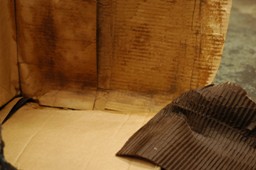
Leaking box |
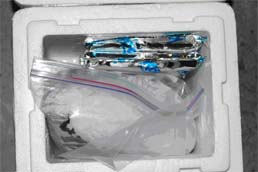
Cadaver packaged properly for submission |
NOTE: According to the U.S. Department of Transportation, any person who knowingly violates a requirement of the Federal Hazardous Material Transportation law is liable for a civil penalty of not more than $27,500 and not less than $250 for each violation.
Rabies Testing
Specimen Preparation
Complete, bilateral samples of brain stem, hippocampus and cerebellum are required for rabies testing. A diagnostic test for rabies requires the examination of a complete cross-section of the brain stem and the cerebellum (including the vermis, right and left lobes). If the cerebellum is not available, a diagnosis can be made by examination of brainstem and hippocampi (right and left). If possible, submit the head of large animals and the entire body of small animals.
When submitting only the brain, submit the entire brain. Submit fresh, chilled tissues only; do not fix the brain in chemical preservatives. Refrigerate, do not freeze specimens for rabies testing prior to shipping. However, if specimens have been inadvertently frozen, they may yield satisfactory results; do not thaw them prior to shipping.
Packaging and Shipping
- The specimen should be double-bagged using heavy plastic, and each bag should be properly sealed. Do not use metal twist ties. If the specimen has any sharp, protruding parts such as shattered bone, wrap it in several layers of newspaper first.
- Place double-bagged specimens in an insulated container and surround the specimen(s) with frozen packs. If more than one animal of the same species is submitted in a container, double-check that each specimen is labeled properly.
- Place a copy of the completed BADDL submission form[ ] in an envelope or a clear plastic bag (e.g., Ziplock bag) and either affix it to the outside of the container or place it on the top of the lid of an inner container within an outer secondary container. Do not place forms within the inner shipping container so that they touch bagged specimens.
- Specimens should be either hand-delivered or sent by overnight courier service. Before shipping on Fridays and days before holidays, please call the laboratory to arrange for lab receiving. Specimens can be delivered directly to the BADDL, 2700 N. John Young Parkway, Kissimmee, FL 34741, from 8 a.m. to 5 p.m., Monday through Friday.
Virology
Equine Viral Arteritis Testing
Equine viral arteritis (EVA) testing requires separated serum and should be sent on ice. Ice packs should be contained in sealed plastic bags to prevent leakage.
All samples should be clearly labeled and accompanied by a completed Equine Viral Arteritis Submission Form[ ]. Please note if multiple samples are to be combined or placed on separate reports.
EVA testing is scheduled on Tuesdays and Fridays. All results will be reported on Mondays and Fridays.
If the animal has been vaccinated for EVA or has a prior history of a positive EVA test, please make a note on the submission form. The lab will then complete a titer on the sample at the initial testing, which will give the veterinarian quicker results.
For additional assistance, call (321) 697-1400.
Contact Us
Questions? Please call us at (321) 697-1400.
Program Resources
- Arboviral Encephalitis Case Information Form[ ]
- Contagious Equine Metritis Submission Form[ ]
- Continuation Form for Accession Submission[ ]
- Create Shipping Labels
- Disclaimer for Owner-Submitted Accessions[ ]
- Equine Viral Arteritis (EVA) Submission Form[ ]
- General Submission Form[ ]
- Lab Web Portal
- Laboratory Tests and Fees
- Pay Lab Fees Online
- Tick Identification Submittal Form[ ]


