
Prepare Your Yard for Wildfire

Creating and maintaining a buffer around your home (or defensible space) can reduce the threat and spread of wildfire. Defensible space in your yard extends 30 to 100 feet from your home and includes landscaping such as grass, trees, shrubs or any wildland area that surrounds it. Defensible space can slow down or stop the spread of a wildfire because it distances your home from the embers and radiant heat of active wildfires.
Your yard can be divided into four zones, each needing different forms of preparation.
Zone 1 — Defensible Space Zone
Extends 30 feet from home, buildings, structures, decks, etc.
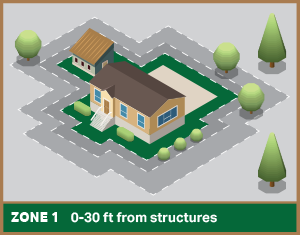
To protect this space:
- Remove all dead vegetation, including plants, leaves, grass and weeds, from your yard, roof, rain gutters, windows and under decks.
- Remove branches that hang over your roof and keep dead branches 10 feet away from your chimney.
- Trim trees regularly to keep branches a minimum of 10 feet from other trees to prevent fire spread in the canopies.
- Relocate wood piles to Zone 2 (see below).
- Create a separation between trees, shrubs and items that could catch fire, such as patio furniture, wood piles, swing sets, etc.
Zone 2 — Fuel Reduction Zone
Extends 30–60 feet from home, buildings, structures, decks, etc.
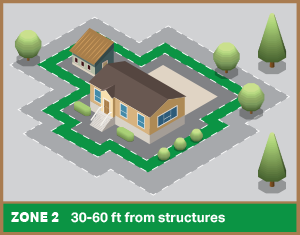
To protect this space:
- Cut or mow annual grass down to a maximum height of 4 inches.
- Create horizontal and vertical space between shrubs and trees by removing vegetation and allowing plants to be separated by groundcover.
- Remove fallen leaves, needles, twigs, bark, cones and small branches.
Zone 3 — Transition Zone
Extends 60–100 feet from home, buildings, structures, decks, etc.
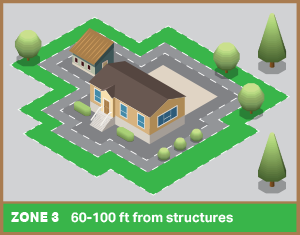
To protect this space:
- Create horizontal and vertical space between shrubs and trees by removing vegetation and allowing plants to be separated by groundcover.
- Remove or trim low-growing vegetation under pine trees.
Zone 4 — Perimeter Zone
Extends 100 feet from home, buildings, structures, decks, etc., and beyond
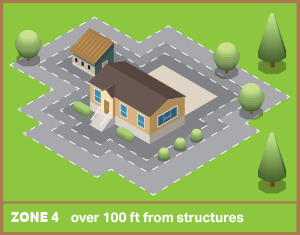
To protect this space:
- Engage in fuel management practices to reduce the risk of wildfire threats and to protect property.
- Be aware of adjacent properties that may be prone to wildfire.
More Yard Safety Resources
-
Ready, Set, Go Resources
[
 3.1 MB
]
. Your personal wildfire action plan (see page 4)
3.1 MB
]
. Your personal wildfire action plan (see page 4) -
Wildfire Risk Reduction in Florida
[
12.6 MB
]
. Home, neighborhood and community best practices (see page 85)


Local Florida Forest Service Dispatch Offices
Chipola Forestry Center
Serving Bay, Calhoun, Gulf, Holmes, Jackson, Walton & Washington counties
- (850) 373-1800 (Main)
- (850) 373-1801 (Wildfires/Authorizations)
- FFSChipola@FDACS.gov (not for emergencies)
- @FFS_Chipola on Twitter
Tallahassee Forestry Center
Serving Franklin, Gadsden, Jefferson, Leon, Liberty & Wakulla counties
- (850) 681-5950 (Main)
- (850) 681-5951 (Wildfires/Authorizations)
- FFSTallahassee@FDACS.gov (not for emergencies)
- @FFS_Leon on Twitter
To report a fire or suspicious smoke, call 911 or your local Florida Forest Service dispatch office.


