
Program Resources
- Florida's Federally Listed Plant Species List (Florida Forest Service)
- Florida's Imperiled Species (Florida Fish and Wildlife Conservation Commission)
Contact Us
For information about Florida's BMP programs or to schedule a site visit, please contact the BMP Forester in your region.
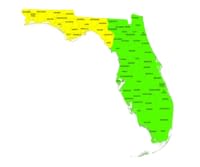
West Florida Region:
Jordan Kimball
Watershed Forester
(850) 681-5942
Jordan.Kimball@FDACS.gov
East Florida Region:
Robin Holland
BMP Forester
(352) 732-1781
Robin.Holland@FDACS.gov
Jarek Nowak, Ph.D.
Program Manager
(850) 681-5883
Jarek.Nowak@FDACS.gov
Wetland Restoration on State Forests
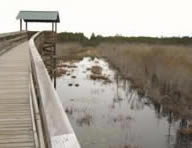
The observation station over a dwarf cypress stand on Tate’s Hell State Forest. The footprint of an old forest road that was removed to restore hydrology to the site can still be seen in the picture.
The Florida Forest Service currently manages over 1 million acres of forest lands across the state of Florida. There is a plethora of diverse natural communities to be found on these public landscapes, many of which are classified as jurisdictional wetlands.
Wetlands play many key hydrologic roles in sustaining the health of our environment. These roles include groundwater recharge, attenuation of floodwaters, and the filtration of nutrients and pesticides that can be present in surface runoff. They also provide food and shelter for many wildlife species, including species that are listed as threatened or endangered. Additionally, many endangered plant species grow exclusively in Florida's wetlands.
Much of the land now managed by the Florida Forest Service has been impacted to varying degrees by previous human activities. Many wetlands found today on state forests had been drained, while others had been impounded or filled in for varying land use purposes in the past. Altering wetlands in these ways not only significantly impacted the natural communities and hydrological functions of the wetlands themselves, but that of adjacent communities and connected off-site water resources as well.
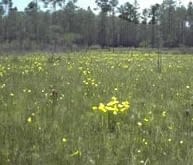
A pitcher plant bog on Blackwater River State Forest, one of many distinct wetland types found on state forests
Healthy, functional wetlands retain stormwater drainage and slowly release it downstream over an extended period of time (hydroperiod), while channelized wetlands quickly release the accumulating rain waters, causing flooding downstream and perhaps causing the wetland to dry out more quickly than normal. In certain parts of the state, such a "dry-down" can make wetlands with deep organic soils vulnerable to muck fires that are difficult to extinguish, causing lingering smoke problems for nearby human developments and traffic corridors.
In addition, such an acceleration of freshwater discharge from wetlands adjacent to saltwater ecosystems can cause problems by rapidly changing salinity levels. This can disrupt fish and invertebrate breeding cycles and reduce the shellfish populations in these areas.
In view of these effects on wetland communities, the Florida Forest Service has made wetland restoration a part of our total resource management strategy on state forests. Through partnerships with the state's five Water Management Districts, the Florida Department of Environmental Protection, and other public and private entities, many areas of impacted wetlands on state forests have been restored to healthy and fully functional wetland ecosystems.
Program Resources
- Florida's Federally Listed Plant Species List (Florida Forest Service)
- Florida's Imperiled Species (Florida Fish and Wildlife Conservation Commission)
Contact Us
For information about Florida's BMP programs or to schedule a site visit, please contact the BMP Forester in your region.
West Florida Region:
Jordan Kimball
Watershed Forester
(850) 681-5942
Jordan.Kimball@FDACS.gov
East Florida Region:
Robin Holland
BMP Forester
(352) 732-1781
Robin.Holland@FDACS.gov
Jarek Nowak, Ph.D.
Program Manager
(850) 681-5883
Jarek.Nowak@FDACS.gov


