To Report Timber Trespass
Timber trespass involves the harvest of trees without a landowner’s permission. This act can be either intentional or accidental.
If a landowner suspects timber theft or other illegal activities such as dumping or vandalism, they may report this activity by contacting a city or county law enforcement official or by calling the Office of Agricultural Law Enforcement at 1-800-342-5869.
Rely on the Experts to Help with the Planning and Sale of Your Timber
Selling timber can be a source of great satisfaction to a landowner, but it can also be a source of surprise, frustration and stress, especially for landowners who only periodically sell their timber. It is most beneficial to sell timber and other forest products in a competitive market to obtain the best return on investment, while meeting your own management objectives. Success requires careful planning and preparation before advertising or talking to prospective timber buyers.
A professional forester, consultant or Master Logger who knows current market conditions can help with harvest planning, accessing your timber’s current market value and assisting with timber sale administration. They can also help prevent surprises for both the seller and buyer, and ensure that both parties are satisfied with the end results.
To find a qualified forester or forestry consultant, please visit the Forest Services Vendor Database and/or the University of Florida’s Forest Stewardship Businesses and Services Directory.
Develop a Forest Management Plan
Compared to non-managed forests, properly managed forests yield more timber, have a higher net present value, suffer fewer environmental impacts, improve wildlife habitat and provide other enhanced resource benefits. A written forest management plan developed by a professional forester and/or natural resource consultant can help ensure that your forest land is managed properly. In addition, a forest management plan is often required for agricultural tax classification and for third-party certification and future markets, such as woody biomass and carbon sequestration.
A forest management plan outlines a landowner’s resource objectives, identifies the steps necessary to attain goals, provides a timetable to guide management activities and is the first step toward a successful timber harvest. Although not required, landowners should strongly consider obtaining a forest management plan for their property. A professional forester can assist with the development of such a plan.
Pre-Harvest Planning
Pre-harvest planning will help ensure that a landowner’s forest management objectives and goals are upheld. It will reduce misunderstandings between the seller and the buyer and/or logger, help ensure that the harvest will maximize financial returns for all parties, help protect water quality, and maintain or enhance forest productivity.
Consider the following steps during the pre-harvest planning process:
- Clearly mark the timber sale boundary to help ensure that the logger avoids cutting non-designated trees outside the sale boundary and/or trespassing on a neighbor's property.
- Use topographic maps to help identify features such as streams, existing roads, property boundaries, steep grades and road access. Soil maps will help identify wet areas and soils that can be easily damaged during the logging process. The use of topographic and soil maps can also help determine not only the time of year to harvest, but potential locations for logging decks, stream crossings, culverts and temporary roads.
- Designate any areas adjacent to streams as Special Management Zones (SMZs) where timber harvesting should be controlled or avoided. Guidelines for harvesting timber are outlined in Florida’s Silviculture Best Management Practices (BMP) manual.
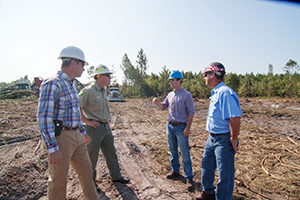
- Conduct an on-the-ground meeting before harvesting begins between the seller or representative, the buyer and the logger to review the management plan for any pre-harvest instructions for the logger/buyer.
By taking the time to conduct a pre-harvest meeting, you can avoid time and money spent on unintended problems such as illegal activities, water quality issues, more forest land impacted by skidding, compaction and/or erosion of forest soils, trees becoming more susceptible to disease and insect damage, and other degraded forest conditions.
Determine a Selling Method: Negotiation or Sealed Bid
Timber is generally sold by one of two methods: negotiation or sealed bid. Landowners should seek advice from a professional forester to determine which method is best depending on their harvesting objective(s).
- Negotiated Sales - Seller arrives at a price after face-to-face bargaining with potential buyers.
- Sealed Bid Sales - Seller advertises sale to as many potential buyers as possible and receives confidential written offers that are opened at a specific time and place. The seller may set a minimum acceptable bid, whether method of payment is via lump sum or per unit, and reserve the right to reject any and all bids received.
Generally, the sealed bid method may return the highest dollar value in competitive markets, especially if the seller is unfamiliar with timber values and/or when the area to be harvested is large and uniform. Negotiated sales are more prevalent where access to markets is limited and/or bidders are few, the tract is small and/or irregular, the timber volume is small and/or it is a salvage sale. Whichever sale method is selected, the seller should require the logger to be a designated Florida Master Logger.
A Master Logger can ensure that trees are effectively harvested and merchandised in a manner that fully utilizes Best Management Practices. This is particularly important as more emphasis is being placed on protecting and enhancing water quality and wildlife. It is good practice to take time to research the prospective logger by asking for references and business experience, and whether they have completed Master Logger training. To verify that a logger has completed this training, visit the Florida Forestry Association’s Master Logger Search Tool.
Determine a Payment Method: Lump Sum or Per Unit
An important step in marketing timber is deciding on the method of payment. The two methods of payment include lump sum and per unit. For a lump sum method, the seller and buyer agree on a total price for the timber before it is cut. This may be done by using the negotiation method or the sealed bid process. In using the lump sum method, the seller receives full payment up front and the risk of timber loss due to wildfire, hurricane, insect or disease damage, or other damaging agent, is transferred to the buyer.
For the per unit method, which is the most common payment method, the seller and buyer agree on a per unit price and specifications for each product class (i.e. pulpwood, chip-n-saw, sawtimber, etc.) prior to the harvest. Typically, there is an advance payment and/or security deposit, with subsequent payments made as timber is harvested. With the per unit method, the seller retains ownership of the timber and associated risk of loss until the harvesting is concluded.
There are certain advantages and disadvantages with each payment method and for this reason sellers are encouraged to seek the advice of a professional forester before making a final decision on which option is best for their specific situation.
Have a Contract
A written contract is essential and will reduce surprises to the seller and the buyer and/or logger. A professional forester or Master Logger can help prepare a timber sale contract. Contact a local Florida Forest Service county forester to find out about items to include in a timber sale contract. Preparing a contract encourages forethought and planning, minimizes difficulties, helps avoid misunderstandings and ensures that the overall transaction meets everyone’s expectations. A sale contract is not a substitute for good faith and fair dealing between parties, but provides a framework in which good faith and fair dealing can operate in an orderly and effective manner.
The following are some items that should be included in a timber sale contract:
Timber Description
- An Accurate Legal Description: In the contract, state the exact location and legal description of the timber sale area.
- Marking Corners and Boundaries: The contract should state at whose expense marking will be done and how the boundaries and corners will be marked. To protect the seller and buyer, a complete title search should be conducted prior to signing a timber sale contract to establish property boundary lines and confirm rightful ownership.
- Selling Timber on a Per Unit Basis: If you choose to sell timber by the unit, specify the units of measurement to be used, who is to do the measuring, and where the measuring is to be done. Measurements may be made by one of several different methods: log scales, weight (i.e., tons), cords or some combination of these. A per unit sale should specify that all timber harvested is to be measured and paid for according to its most valuable product use.
- The Type of Harvest: Specify the desired type of harvest and, if the timber is marked, specify how it is to be marked. For example, to avoid the cutting of seed trees, the seller may specify that all trees banded with paint 4.5 feet above ground (Diameter at Breast Height or DBH) are designated as seed trees and are not to be cut or damaged. For thinning or select harvests, it is advisable to designate the trees to be cut with one paint spot above DBH and another below the stump height. If planning an operator-select harvest, specify selection guidelines in the contract and consider marking the designated types of cut trees in a sample area of less than an acre for the logger to reference. Make sure the paint color is different than the paint used for sale and property boundaries.
Payment, Damage Clauses and Penalties
The following are conditions to consider including in a timber sale contract. Be aware that some restrictions placed on harvesting may lower the price someone is willing to pay for your timber, so be reasonable in your expectations.
- Selling Timber on a Lump Sum Basis: A lump sum sale is the outright sale of standing timber for a fixed dollar amount agreed upon in advance. A minimum acceptable bid will be based on a pre-sale timber volume estimate rather than the actual volume cut. If selling timber on a lump-sum basis, specify that payment must be made in full at the time of contract execution; or if deferring payment, the exact date(s) payment is to be rendered.
- Selling Timber on a Per Unit Basis (Price): For a per unit sale, the price is determined in advance, but the amount of timber to be harvested is not. Income from the sale is strictly based on the volume actually harvested. If selling on a per unit basis, specify the payment per unit for each species and product, as well as timing of payments. Additionally, agree on the method and place of scaling and measurement. The contract should stipulate that the buyer provide the seller with a complete accounting of all species and products harvested from the sale area by delivery point.
- Time Period for Cutting Timber: Normal time periods for cutting timber are six to 24 months, and are often dependent on tract size and weather. There can be provisions for sale contract extensions, but the details and timing of the extension should be defined.
- Damage to Your Land or Remaining Timber: A certain degree of damage should be expected. The seller may want to visit a comparable site that has been recently harvested by the same logger who will harvest their tract. Also, the seller may want to state damage requirements, such as no more than a maximum number of trees per acre having visible skidding damage, or specify the acceptable depth (in inches) of skidding ruts.
- Access Restrictions: Specify any restrictions regarding ingress and egress to the property. For example, if a logger should avoid using a certain entrance to the property, such as a pasture or an entrance beside your house, specify this as a requirement in the contract.
- Making a Partial Cut: If making a partial cut, include in the contract a penalty for cutting non-designated trees. If a dollar value per merchantable tree volume is specified for the cutting of non-designated trees, later issues can be more easily resolved. Likewise, if the intent is to remove a canopy or overstory to allow a future stand room to grow, you should likewise specify a penalty for failure to cut designated trees.
- Logging Notification: Agree on when logging can begin and ask to be notified prior to the logger moving on to the sale site.
Logging Clauses
- Method of Logging: The seller may specify a certain method of logging be used, such as a forwarding system instead of tree-length skidding, to minimize damage to a residual stand during a thinning operation.
- Road Maintenance and Skid Trail Layout: If roads are to be maintained to a minimum standard, refer to that standard in the contract. A usual requirement is to return roads to as good or better condition than before logging occurred. Address expectations for the repair of fences or other special places that may be damaged during the harvesting operation.
- Reduce the Possibilities for Non-Point Source Pollution: The seller should specify that all logging must be done in accordance with Florida’s Silviculture Best Management Practices (BMPs).
- Stump Height and Top Diameter Harvested: If stump height and top diameter harvested is important, specify, in inches, the maximum stump height allowed or top diameter. To easily machine-plant your next timber stand, allow a maximum stump height over which the tree planter can easily maneuver.
- Selling Your Timber Based on Unit Volume: If selling timber based on unit volume, be sure to specify the maximum top diameter allowed to remain in the woods.
- Cleanup: Include a statement requiring removal of all litter and trash from the logging operation. You may also want to specify that logging debris be scattered back over the site rather than piled at the logging deck.
Sale and Harvest
Arrange a meeting with the buyer and/or logger so that you or your representative can point out any special restrictions that have been imposed. Walk the sale site to ensure sale boundary lines and other restrictions are understood by all. Check the logging operation on a regular basis and inform the logging supervisor if you feel that the terms of the contract are not being faithfully followed. Be reasonable in your expectations and assignment of damage penalties. In some instances, the amount that you receive for your timber may be reduced due to excessive restrictions.
Other Contract Provisions to Consider
- Name and address of buyer;
- Date contract is executed;
- Declarations of the seller’s ownership and right to convey (this may include a title abstract and insurance);
- Clarify ownership of by-products;
- Liability insurance from all contractors and sub-contractors (it is a good idea for the seller to be added to the contractor’s insurance as an additionally insured party);
- Statement designating the party or parties who suffer the loss if timber is destroyed or stolen;
- Provision for or against assignment of the contract;
- Notarization of the contract (only if document is to be recorded);
- Recording of the contract at the local county courthouse;
- Performance bond or deposit, collected from the buyer prior to the commencement of harvesting, to be held until the provisions of the contract are met; and
- Requirement of Master Logger certification for the logger.
Monitor the Harvest
Check the logging operation on a regular basis to ensure contract requirements are being met. For per unit sales, always require a full accounting of that which is being harvested. This information should be provided by the buyer. The frequency with which this information is provided can be determined by the seller, but it is recommended that information be provided on a regular time schedule (i.e., weekly, monthly, etc.).
Requiring a load-by-load accounting of forest products removed from the timber sale is a good business practice for both the seller and the buyer. Doing so ensures a full accounting of which products are harvested off the property and helps ensure that contractual terms are fulfilled.
Record Keeping on Per Unit Sales
- Load number
- County and state of origin
- Landowner’s name
- Date and time
- Scale ticket number
- Species and product
- Destination
- Purchaser
Closeout with Buyer/Logger
A notice of completion of harvest from the buyer can be helpful in removing any question about whether or not the buyer considers the harvest complete and relinquishes any remaining biomass back to the owner. Parties should review and agree on the specific type and schedule of follow up action(s) regarding any land or timber damages as a result of the harvesting operations. Also, ensure that the operation was conducted in compliance with Silviculture Best Management Practices. Finally, address any other issues related to non-compliance of the contract.