
Lake Talquin State Forest

Total Acreage: 19,380
Counties: Gadsden, Leon, Liberty
Recreation and Amenities
Trails:
- Hiking, biking, horse and birding
- Big Bend Scenic Byway
Recreation Reservations and Fees: Visit ReserveAmerica.com or call 1-877-879-3859.
Water: Boat ramp, canoe launch, dock and fishing
Other:
- Hunting, nature study, restroom, pavilion, picnic tables and grills.
- Leashed pets allowed. Contact the forest office for specific information.
Program Resources
- Bear Creek Educational Forest
- Current State Forest Management Plans
-
Lake Talquin State Forest Brochure
[
 3.6 MB
]
3.6 MB
]
-
Lake Talquin State Forest Management Plan
[
704.5 kB
]
- Trailtrotter Program
- Trailwalker Program
Maps:
Smart device mapping is possible and encouraged in the state forests. Before visiting a forest, search for “PDF Maps” in the app store to find an app that works for you and download our state forest map, which is georeferenced.
-
Lake Talquin State Forest Map
[
1.1 MB
]
-
Lake Talquin High Bluff Campground Map
[
72.2 kB
]
-
Lake Talquin High Bluff Campground Map
[
Video: Paddle Florida: Dam to the Bay

Lake Talquin State Forest is part of the Great Florida Birding Trail.
The forest is also part of the Big Bend Scenic Byway.
Contact Us
(850) 681-5953
Email Lake Talquin State Forest
Florida Forest Service
Lake Talquin State Forest
865 Geddie Rd.
Tallahassee, FL 32304-8671

Lake Talquin State Forest
Location
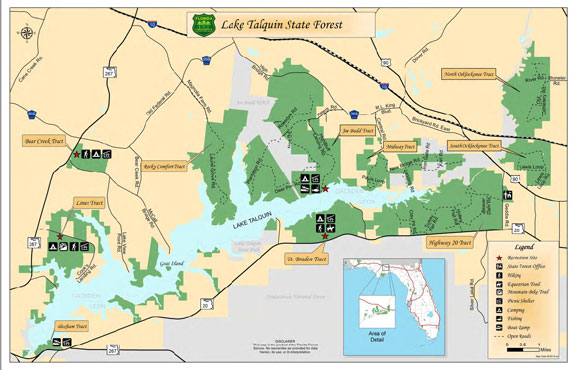
Lake Talquin State Forest is located just west of Tallahassee and is composed of 10 main tracts of land, along with several smaller tracts. Most of the forest adjoins the Ochlockonee River and Lake Talquin, the body of water that gives the forest its name.
Since 1977, Lake Talquin State Forest has been managed by the Florida Forest Service using the multiple-use concept, which balances environmental, recreational and resource use needs. Emphasis is given to reforestation, ecosystem restoration and outdoor recreation.
Located within the state forest, Bear Creek Educational Forest offers free guided programs for students. The programs include activities for students of all ages and are correlated to a number of educational standards.
Lake Talquin State Forest Map
View Large Map
[
1.1 MB
]
General Tract Locations Map

General Tract Locations Map Legend | ||
1. Line's Tract | ||
10. Rocky Comfort Tract | ||
Natural Features
Lake Talquin State Forest is composed of a variety of forest cover types. Upland pine forest represents the largest community found on the forest. These rolling pine hills host a wealth of plant and animal diversity. Excellent examples of the slope and ravine forest communities are located on the west side of the Highway 20 Tract and throughout the Fort Braden and Bear Creek tracts. Other natural communities found on the forest include flatwoods, sandhills, floodplain forests and swamps. The presence of the Ochlockonee River and Lake Talquin gives this forest the distinction of having two Outstanding Florida Waters.
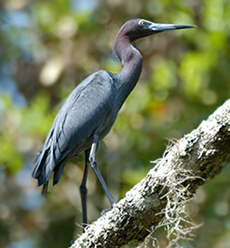
Tree species found in the forest include longleaf pine, slash pine, loblolly pine, American beech, southern magnolia, red maple, sweetgum, hickories, swamp tupelo, bald cyprus, dogwood and various oaks. Many types of wildlife make their home on the forest, including the red-shouldered hawk, bobcat, coyote, osprey, white-tailed deer, fox squirrel, turkey and mourning dove. Bald eagles, currently listed as a threatened species, can be seen soaring above the treetops. Gopher tortoise, a species of special concern, also lives throughout the forest.
Recreation
A wide variety of recreational opportunities await visitors to Lake Talquin State Forest. Hiking, camping, horseback riding, biking, picnicking, birding and nature study can be enjoyed using existing service roads, old road beds and established trails.
Freshwater fishing can be pursued from the shore or by boat, and several public boat ramps are located on the lake. Canoes, kayaks and power boats are allowed. Lake Talquin State Forest is part of the Big Bend Scenic Byway, which is a designated Florida Scenic Highway.
Visit the Recreation Page for Lake Talquin State Forest.
Managing the Forest
In the mid-1970s, prior to state ownership, much of this land’s timber was removed under a long-term timber contract. Since taking over management, the Florida Forest Service has managed for reforestation, ecosystem restoration and outdoor recreation.
Timber management practices on Lake Talquin State Forest are important in the restoration and maintenance of forest ecosystems and provide a variety of socioeconomic benefits to Floridians. Harvesting activities follow the Florida Department of Agriculture and Consumer Services guide to Silviculture Best Management Practices (BMPs).
Trees are planted in order to restore natural communities while small areas are left treeless as wildlife openings. Whenever large clearings are performed, it is to replant to the most suitable tree species for the site or to remove diseased or dying trees.
Wildlife habitat management is of crucial importance on Lake Talquin State Forest and is a key consideration whenever other management decisions are made. Prescribed burning is an important management tool and is used on much of the forest in a two to four year interval. This mimics natural fires, keeping the ecosystems healthy and encouraging the growth of plants that produce food for wildlife.
Lake Talquin State Forest
Total Acreage: 19,380
Counties: Gadsden, Leon, Liberty
Recreation and Amenities
Trails:
- Hiking, biking, horse and birding
- Big Bend Scenic Byway
Recreation Reservations and Fees: Visit ReserveAmerica.com or call 1-877-879-3859.
Water: Boat ramp, canoe launch, dock and fishing
Other:
- Hunting, nature study, restroom, pavilion, picnic tables and grills.
- Leashed pets allowed. Contact the forest office for specific information.
Program Resources
- Bear Creek Educational Forest
- Current State Forest Management Plans
-
Lake Talquin State Forest Brochure
[
3.6 MB
]
-
Lake Talquin State Forest Management Plan
[
704.5 kB
]
- Trailtrotter Program
- Trailwalker Program
Maps:
Smart device mapping is possible and encouraged in the state forests. Before visiting a forest, search for “PDF Maps” in the app store to find an app that works for you and download our state forest map, which is georeferenced.
-
Lake Talquin State Forest Map
[
1.1 MB
]
-
Lake Talquin High Bluff Campground Map
[
72.2 kB
]
-
Lake Talquin High Bluff Campground Map
[
Video: Paddle Florida: Dam to the Bay
Lake Talquin State Forest is part of the Great Florida Birding Trail.
The forest is also part of the Big Bend Scenic Byway.
Contact Us
(850) 681-5953
Email Lake Talquin State Forest
Florida Forest Service
Lake Talquin State Forest
865 Geddie Rd.
Tallahassee, FL 32304-8671


