
Program Resources
Presentations:
-
2020 ESA Poster Presentation
[
 2 MB
]
2 MB
]
-
2019 IRCHLB Poster Presentation
[
1.3 MB
]
3D Printing Lab
The Florida Department of Agriculture and Consumer Services' (FDACS) Division of Plant Industry has a 3D printing lab that produces customized products for the monitoring or management of invasive pests across the U.S. Objects are designed using computer software and printed using a 3D printer, which deposits successive layers of heated plastic until the object is created.
Psyllid Trap
The Asian citrus psyllid, Diaphorina citri, is one of the known vectors associated with citrus greening disease. Both the disease and the vector are established in Florida, but the disease is not widespread in California. With monitoring and DNA testing of psyllids in key areas, California hopes to contain the disease spread.
A trap was created for the Asian citrus psyllid that has near-equal trapping rates to the industry-standard yellow sticky card — with the added ability to preserve the psyllids for DNA analysis as a means of early detection of the bacteria associated with citrus greening.
These traps are also successful at catching other psyllids, including the potato psyllid, Bactericera cockerelli (Šulc), which can harbor the bacterium that causes zebra chip disease, and the pear psyllid, Cacopsylla pyricola (Forster), which can harbor the pathogen that causes pear decline.
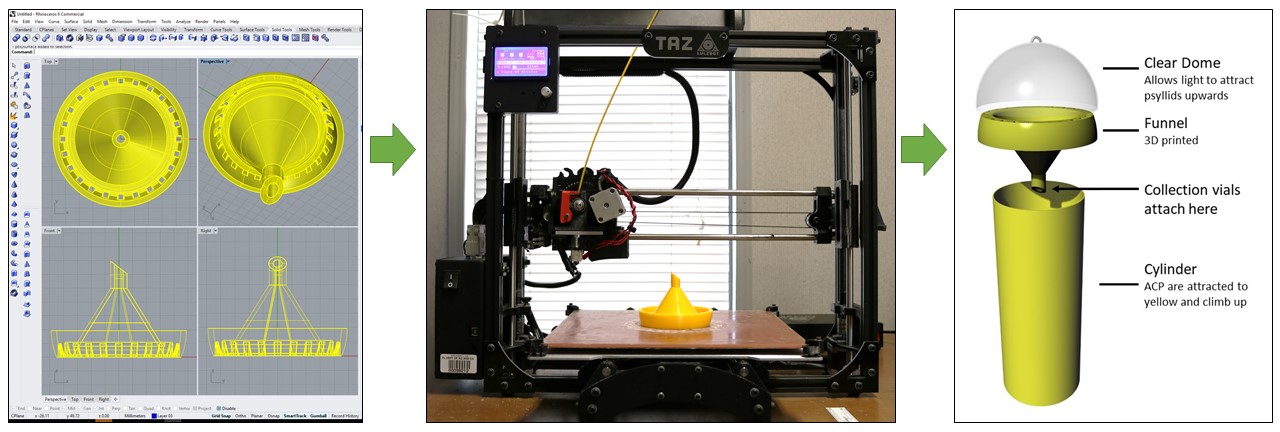
Rhinoceros modeling software, 3D printer, and psyllid trap components

Asian citrus psyllids

Laboratory choice tests

Field efficacy testing
Olfactometer Arena
Dr. Tolulope Morawo with the Invasive Arthropod Biological Control Program at the UF/IFAS Indian River Research and Education Center requested a four-way olfactometer arena to test how Asian citrus psyllid biological control agents find their host amid background plant volatiles.
A plastic arena was made, customized to fit olfactometer parts in Dr. Morawo’s lab.

Four-way Olfactometer Arena
Cotton Aphid Trap
The UF/IFAS West Florida Research and Education Center requested a water trap for the cotton aphid, Aphis gossypii.
The height of the pan was made adjustable by using a mounting coupler cinched onto the center pipe. Three small holes were designed near the rim of the pan and 3D-printed mesh plugs were inserted. This allows excess rainwater to drain while keeping specimens inside.

Aphid. Photo: J.L. Castner, UF

Pan trap

Close-up of drainage plugs in pan trap
Thrips Collection Device
Brazilian peppertree, Schinus terebinthifolius Raddi, is a non-native noxious weed in Florida. FDACS runs a biological control program for Brazilian peppertree, mass-rearing the thrips Pseudophilothrips ichini (Hood), as a biological control agent. These thrips are minute in size making hand collection difficult and often resulting in organism injury or mortality.
We designed a funnel to passively collect the thrips using a jug placed on top of the host plant nursery pot. Emerging thrips are attracted to the new plant material in the vial and climb upward through the funnel and into the trap.

Thrips. Photo: M. Vitorino, University of Blumenau

Brazilian peppertree. Photo: C. Minteer, UF/IFAS

Device components
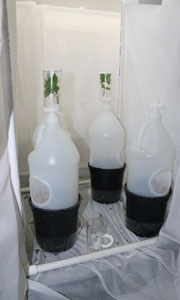
Assembled thrips collection setup
Fly Bait Station
Exotic fruit flies are a major problem in Florida and can result in large economic losses to the fruit production industry. Monitoring is crucial for early detection and management. The FDACS Division of Plant Industry fruit fly research lab requested a fruit fly bait station to deploy bait for various exotic fruit flies in the field.
A coconut fiber disk with a liquid pesticide bait is sandwiched between a 3D-printed weatherproof dome and a plastic grid. A bolt passes through the top of the dome and is secured with a wing nut to keep the disk and grid in place.
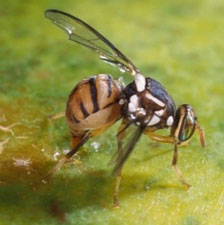
Fruit fly. Photo: Scott Bauer, USDA

Bait station measurements
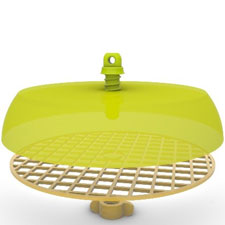
Bait station components
Corn Earworm Trap
The UF/IFAS West Florida Research and Education Center requested a trap for emerging pupae of the corn earworm, Helicoverpa zea, to understand pupal survival rates and active times, and collect samples for genetic studies.
A plastic mesh funnel was made to screw onto commercially available jars for easy access to caught specimens. Funnels were glued to large portable mesh tents that lay over the ground to catch emerging pupae from the soil.

Corn earworm larva. Photo: John Capinera, UF

Corn earworm adult. Photo: John Capinera, UF

Plastic mesh funnel as a trap component
Giant African Land Snail Trap
Giant African land snail, Lissachatina fulica, is a pest throughout the worldwide tropics and eats over 500 types of plants. Research continues to develop new control measures for this gregarious pest.
The 3D Printing Lab has created a trap to aid the eradication program of the giant African land snail, and work continues to improve its efficacy.

Snail trap design, 3D printer and fully assembled snail trap
Program Resources
Presentations:
-
2020 ESA Poster Presentation
[
2 MB
]
-
2019 IRCHLB Poster Presentation
[
1.3 MB
]


